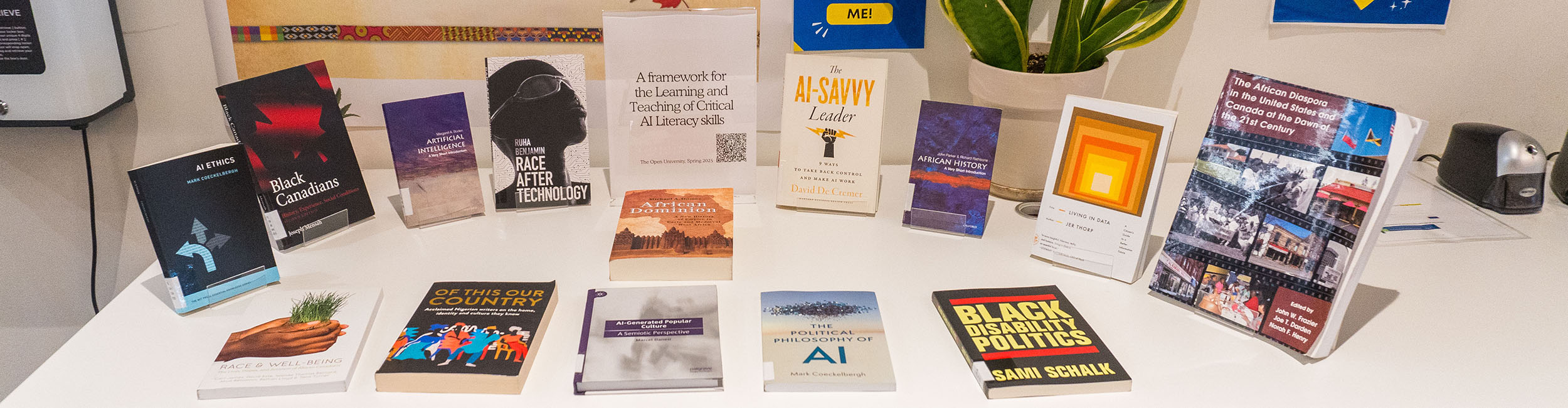
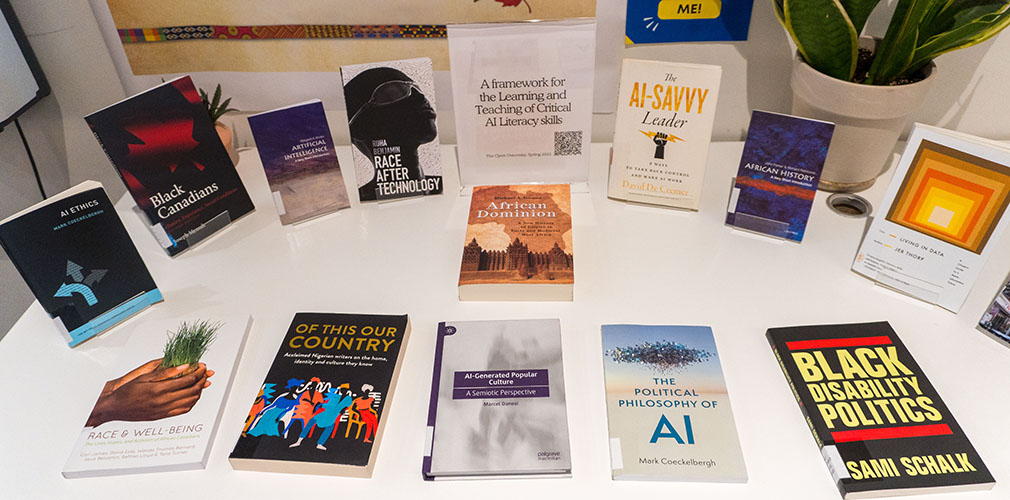
This February Alexander College’s library is celebrating Black History Month. Last year the library explored Canadian history and uplifting future generations. This year the intent is to examine art and technology with a critical lens.
This is the Honey: an anthology of contemporary Black poets (2024) – edited by Kwame Alexander
Poetry is an art form in which individuals express, among many possibilities, their thoughts, emotions, and lived experiences. This can be done on an individual level, but also on a cultural level. We can learn about the lived experiences of Black people all around the world through reading poetry written with the purpose of sharing that lived experience.
Kwame Alexander is a poet with many different accolades, including the Cybil Award for Poetry, the Carnegie Medal, and the Newberry Medal. His carefully selected book of poems shares different dimensions of experiences living as a Black person as an individual and as a member of a rich, vibrant culture.
For example, Nate Marshall wrote a poem about the unique comfort food that is a staple of African American cuisine. Intersectionality, or when two identities overlap, is also brought up by Jacqueline A. Trimble in her poem about being a Black woman. In short, if you enjoy poetry, this would be a great way to expand your horizons and empathize with and learn from Black experiences.
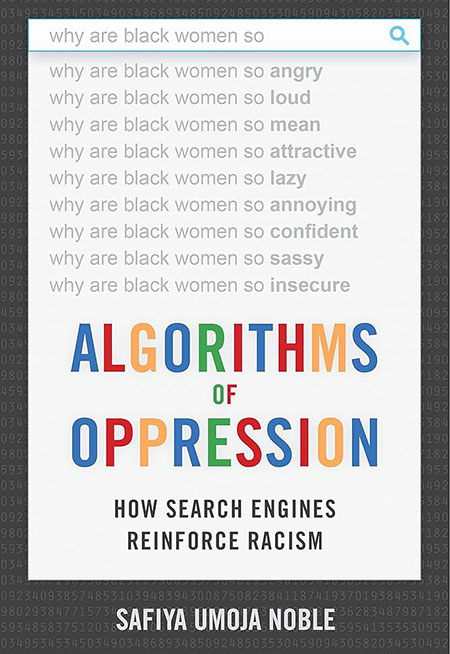
Algorithms of Oppression (2018) – Safiya Noble
Safiya Noble is a professor of social sciences and professor of gender studies, African American studies, and information studies at the University of California, Los Angeles. As a student, she noticed that when she searched on Google for resources on Black women and girls, the algorithms would provide racist and/or sexist information.
In Google searches, the search algorithm decides which web pages are most relevant to what you searched for and ranks them in order on the results page. It’s supposed to make things convenient for everyone involved, but the algorithms showed clear bias against Black women and girls. Safiya Noble investigates how this could have happened and makes suggestions for avoiding bias in future technologies.
Unmasking AI: my mission to protect what is human in a world of machines (2024) – Joy Buolamwini
Just like Safiya Noble’s book, discussed earlier, Dr. Buolamwini’s text deals with encoded discrimination and exclusion in technologies. She notes that AI should be for the people and by the people, but often Black people suffer from racism, sexism, and ableism that intersect and magnify discrimination. This can be seen in technologies that are supposed to predict crime.
The author mentions how some jurisdictions of the justice system in the United States were experimenting with software to predict if people convicted of crimes would re-offend, and the software disproportionately targeted Black people as likely to re-offend. The author writes that this is only one example of human bias becoming encoded in digital technologies.
Learn more about the fascinating world of bias, technology, and strategies to avoid it. Check out this book today!
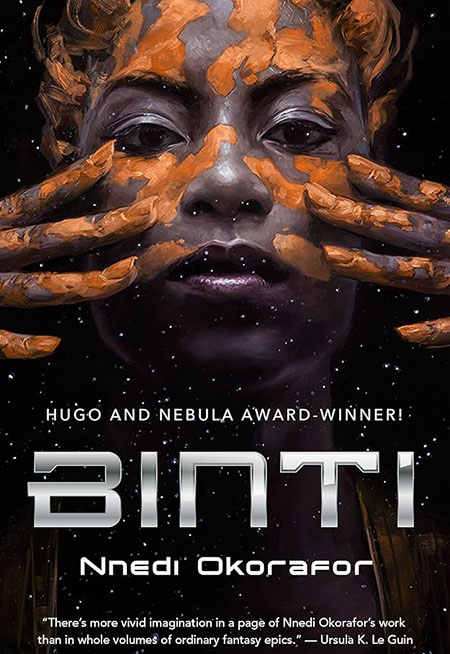
Binti (2015) – Nnedi Okorafor
This book is classified as Africanfuturist science fiction. Africanfuturism is a cultural approach to art and science that focuses on the combination of African culture, history, mythology, lived experiences, with technology. It is a wonderful way for young Black readers to identify with science and technology and get interested in those fields, which have often been shut to them due to systemic racism.
This book is about a student who is accepted into the highly desired intergalactic university called Oomza Uni. She meets many people and aliens along the way, some of whom have her best interests at heart, and not so much. Black History Month is not just about history; it’s about celebrating Black people and cultures, as well as charting an exciting path forward to more equality, and more Black empowerment.
Read about her epic journey of self-discovery, African identity, and speculations about the future of technology!
Race After Technology (2019) – Ruha Benjamin
In today’s world, there are new technologies that are rapidly developing, including Artificial Intelligence. Ruha Benjamin’s book discusses how such technologies can encode racism and bias. In other words, they are not neutral. Consider the example of a radio. If racism is expressed on the radio, we blame the person speaking, and not the radio.
This kind of thinking cannot be applied to emerging technologies like AI. Instead, AI can be racist and biased. AI does not soar above society, free from conflict and bigotry. AI can absorb society’s conflict and bigotry.
For example, AI can learn from past hiring history. Since systemic racism has often excluded Black people, the past hiring history would have fewer Black people. Therefore, using this system, the AI would filter out Black applicants, even if they were highly qualified. Learn more about critically examining AI by reading this title today!
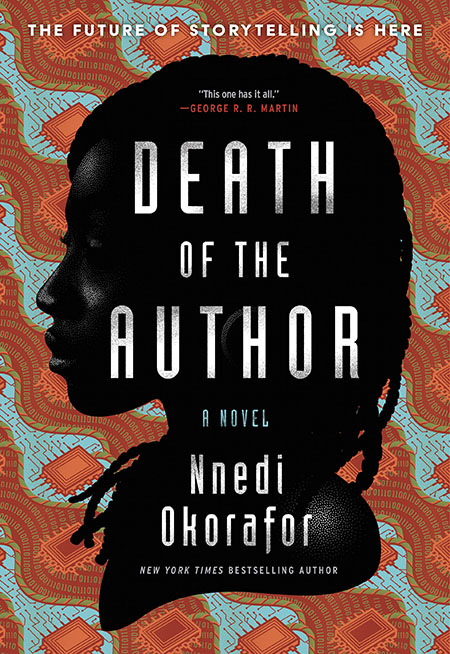
Death of the Author: a novel (2026) Nnedi Okorafor
This novel is about a disabled Nigerian American author who writes an amazing science-fiction novel that becomes a cultural sensation, just like Harry Potter did. The novelist dies, but her book continues to increasingly influence society. The story explains scenes from the novelist’s life, what got her to write the book, and her hopes and dreams.
Readers will also read excerpts from the fictional novel and be inspired by its Africanfuturist vision. Overall, it is a novel about how writers can often lose control of their work once their work is put into the world. The work can be made to justify actions that the author may have never considered. It shows how one person with an idea can change the world, often in unpredictable ways. Check out this book from AC Library today!
Alexander College acknowledges that the land on which we usually gather is the traditional, ancestral and unceded territory of the Coast Salish peoples, including the territories of the xʷməθkwəy̓əm (Musqueam), Skwxwú7mesh (Squamish), and Səl̓ílwətaʔ/Selilwitulh (Tsleil-Waututh) Nations. We are grateful to have the opportunity to work in this territory.
Alexander College acknowledges that the land on which we usually gather is the traditional, ancestral and unceded territory of the Coast Salish peoples, including the territories of the xʷməθkwəy̓əm (Musqueam), Skwxwú7mesh (Squamish), and Səl̓ílwətaʔ/Selilwitulh (Tsleil-Waututh) Nations. We are grateful to have the opportunity to work in this territory.

+1 604-435-5815
#100 - 570 Dunsmuir St.,
Vancouver, BC
V6B 1Y1 Canada


